BY JENNIE REES, NATIONAL HBPA COMMUNICATIONS (Edited)
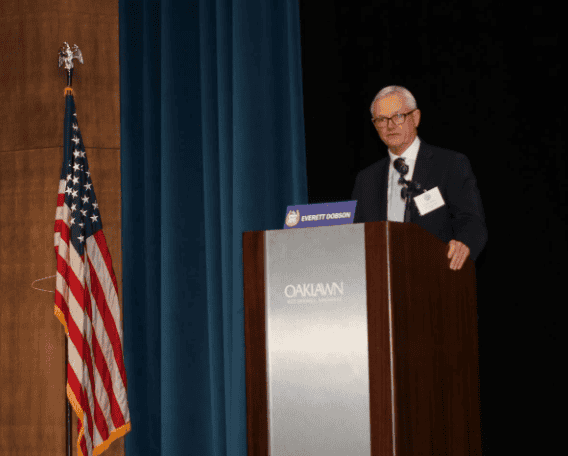
HOT SPRINGS AR—New Jockey Club chair Everett Dobson gave every sign that his leadership of North America’s powerful Thoroughbred breed registrar will be built on a strategy of inclusion and thinking big.
In delivering the National Horsemen’s Benevolent & Protective Association Conference’s keynote address on Wednesday at Oaklawn Park, Dobson said he will collaborate with horsemen to find solutions to horse racing’s many challenges and ways to grow the sport. It also means meeting with stud farms to revisit the controversial issue of a potential cap on the number of mares that a stallion can breed in a season.
Dobson acknowledged that The Jockey Club and the National HBPA, representing almost 30,000 racehorse owners and trainers, have their differences. That includes The Jockey Club’s support of the Horseracing Integrity and Safety Authority, with the National HBPA challenging in court the enabling federal legislation’s constitutionality.
However, Dobson said there exists much common ground and that a big-table approach is necessary to grow and improve the industry. His comments were extraordinary, given the past acrimony between the organizations, making it clear that Dobson is his own man.
“Our first allegiance is to the horse,” he said. “As I look around this room and look at the mission statement and position statements of the National HBPA, it’s apparent that when it comes to the horse, we are as closely aligned as two organizations could possibly be. The improvement this sport has made in the health and safety of the Thoroughbred racehorse is, I believe, the single-most important thing I’ve seen in my now 30 years of involvement.
“I am also of the belief that credit for that should be spread far and wide, and especially to the great horsemen and women that make up the National HBPA. You are the ones putting your hands on the horse, providing for the care and nutrition needs for every single horse, every single day.”
With that, Dobson went on to make news, saying he wanted to take another hard look at limiting the size of stallions’ studbooks.
The Jockey Club in 2021 proposed capping at 140 the number of mares that a stallion could breed; any more would not be registered and therefore ineligible to race. That swiftly brought a lawsuit from three of Kentucky’s largest stud farms. The Jockey Club dropped the controversial rule change.
Now, Dobson is prepared to take another run, but with a different approach.
“As we think about the health of the Thoroughbred breed, we must not ignore the alarming increase of the coefficient of inbreeding,” he said. “Years ago, The Jockey Club attempted to impose a cap on the number of mares a stallion could breed. Under my leadership, we’re going to revisit that question. This time, we will involve stallion farms and other breed registries around the world to help us find the solution. Our discussions must be science-based with an understanding of the economic realities of the world we live in.”
Dobson — an Oklahoma businessman, tech entrepreneur, philanthropist, horseman and partner in defending NBA champion Oklahoma City Thunder — is the 132-year-old Jockey Club’s first chair who isn’t from the Northeast. His ascent to head the organization follows the 42-year reign of cousins Ogden Mills “Dinny” Phipps and Stuart Janney.
Dobson said that when he was tabbed to replace the retiring Janney, he met individually with all The Jockey Club board members and stewards.
“I’m going to tell you what I told them,” he said. “I think big; I guess I always have. I founded this cellular telephone business when I was in my 20s that became one of the largest in the country. When I started out, I wasn’t thinking, ‘Oh gee, let’s make this a nice little Oklahoma business.’ Quite the contrary. When I joined the seven others to purchase what is now the Oklahoma City Thunder in 2006, we didn’t sit around and discuss the keys to being the operators. No, we discussed what a pathway would look like to a world championship — and it didn’t hurt that we had two Arkansas Razorbacks on the team to do it.”
He said he will take a fresh look at “the business of The Jockey Club.” He gave a sample of what’s to come, telling the audience that his organization — a non-profit with for-profit subsidiaries — will:
- Back a national marketing campaign that builds on The Jockey Club’s America’s Best Racing initiative
- Continue to push for legislation that would permanently ban horse slaughter and the export for slaughter of horses abroad
- Substantially increase its funding for the aftercare of retired racehorses
- Continue to support the traceability initiative to track horses throughout their post-track lives
“We need to know where these horses are,” he said. “But I also believe the most important area of support is retraining and rehoming. The Thoroughbred horse wants and deserves a job in its post-racehorse life.”
Dobson said the industry needs a permanent endowment or endowments “of significant size that will provide a level of certainty for every horse that showcases their talent for our entertainment.” He noted that The Jockey Club already has the Grayson-Jockey Club Foundation that for decades has funded research to improve the health of the horse, as well as The Jockey Club Safety Net Foundation, which helps those in need who work in the industry.
He termed it “the big opportunity” to return Thoroughbred racing and breeding to an era of growth. Beyond the traditional metrics of foal crop, race days, field size, attendance on racing’s big days, he said, “I want this industry to also be one of job growth. We need young people to consider this sport as a viable career.”
Dobson said a positive trend is that major capital projects aren’t restricted to high-profile tracks such as Churchill Downs, Keeneland and Belmont Park but underway at smaller tracks in Nebraska, Wyoming, Arizona and Kansas.
“Thinking big means we don’t ignore the smaller markets,” he said. “Without a doubt, this influx of capital will produce some level of growth.”
However, Dobson said one of the most challenging metrics is the foal crop in regional markets. He said he’s convinced that “states are going to have to broaden their breeding and racing programs in partnership with surrounding states. Fortunately, I’m hearing that there are meaningful conversations underway.”
But, he continued, “Nothing big in the sport will happen if we can’t improve fan engagement…. We can reach new fans. I’ve seen it in the NBA.”
While there is incredible fan engagement in pockets around the country such as Oaklawn, Keeneland, Saratoga and Del Mar, Dobson said “our mission is to expand that reach by looking at what is successful and develop that relationship with new and younger fans on a continuous basis.
“… I have become a big advocate for a national marketing campaign, one that will focus on messaging that elevates this sport in the eyes of the general public. A few years ago, The Jockey Club launched America’s Best Racing, through which we had an influencer program last year that was a huge success. That program will be expanded this year and play a key role in a more comprehensive national marketing campaign. Broadly speaking, we are in an entertainment business. We compete with other sports and other forms of gaming, but we have an amazing story to tell. It’s time to start talking.”
At the heart of progress is working together, he said.
“Sports and sports leagues function best when there is collaboration toward the common goal,” Dobson said. “My belief is that horse racing can raise to a far higher level of participation and fan engagement. For that to happen, we need collaboration and unification…. For this sport to move forward, it will take a team: the horsemen and women that rise before dawn, the track operators that are reinvesting in their infrastructure, the breeders who take long-term risk, the bettors who support us every day, those that buy our yearlings and 2-year-olds at the sales. It will take all of the industry organizations working together, and it will take those organizations working with HISA and HISA working with us. If we were serious about thinking big — truly big — our future … will be built at the big table. Tables where we check our egos at the door, where we debate vigorously, disagree honestly, but being aligned around the common purpose.
“Can we elevate this sport to a level that hasn’t been seen in a generation? I believe we can, with commitment, collaboration, integrity, unification and a big dose of big ambition. I am standing before you because I believe the best days of Thoroughbred racing are not behind us. They are in front of us.”
Dobson’s big-tent philosophy is a theme regularly used by National HBPA CEO Eric Hamelback, who has known the lifelong Oklahoman for years.
“When Eric asked me to address this group, he called and said, ‘You may want to think about it. You may want to ask your board,’” Dobson said. “Instead, I accepted without hesitation, on the spot. It didn’t hurt that it was being held at the place where I first experienced Thoroughbred racing. … The question I try to apply at this stage in my life and every hard decision I have to make, and that is: Is it something I truly want to work on, and will I get to work with people I want to work with. I can tell you, working for the betterment of the sport, and working with people like Eric Hamelback satisfies both for me.”
After Dobson’s 18-minute remarks, Hamelback responded in kind.
“I appreciate Everett for his words. I appreciate bringing new life to The Jockey Club,” Hamelback said. “We hope in the future there is more collaboration and ultimately working with us and working together, as opposed to just two trains speeding down the track.”
Return to the March 5 issue of Wire to Wire