
PRESS RELEASE
LEXINGTON, KY—The Horseracing Integrity and Safety Authority today announced the publication of its 2026 Second Quarter Metrics Report. This report provides a detailed analysis of key performance indicators related to the safety and integrity of Thoroughbred racing in the United States.
Equine Fatalities
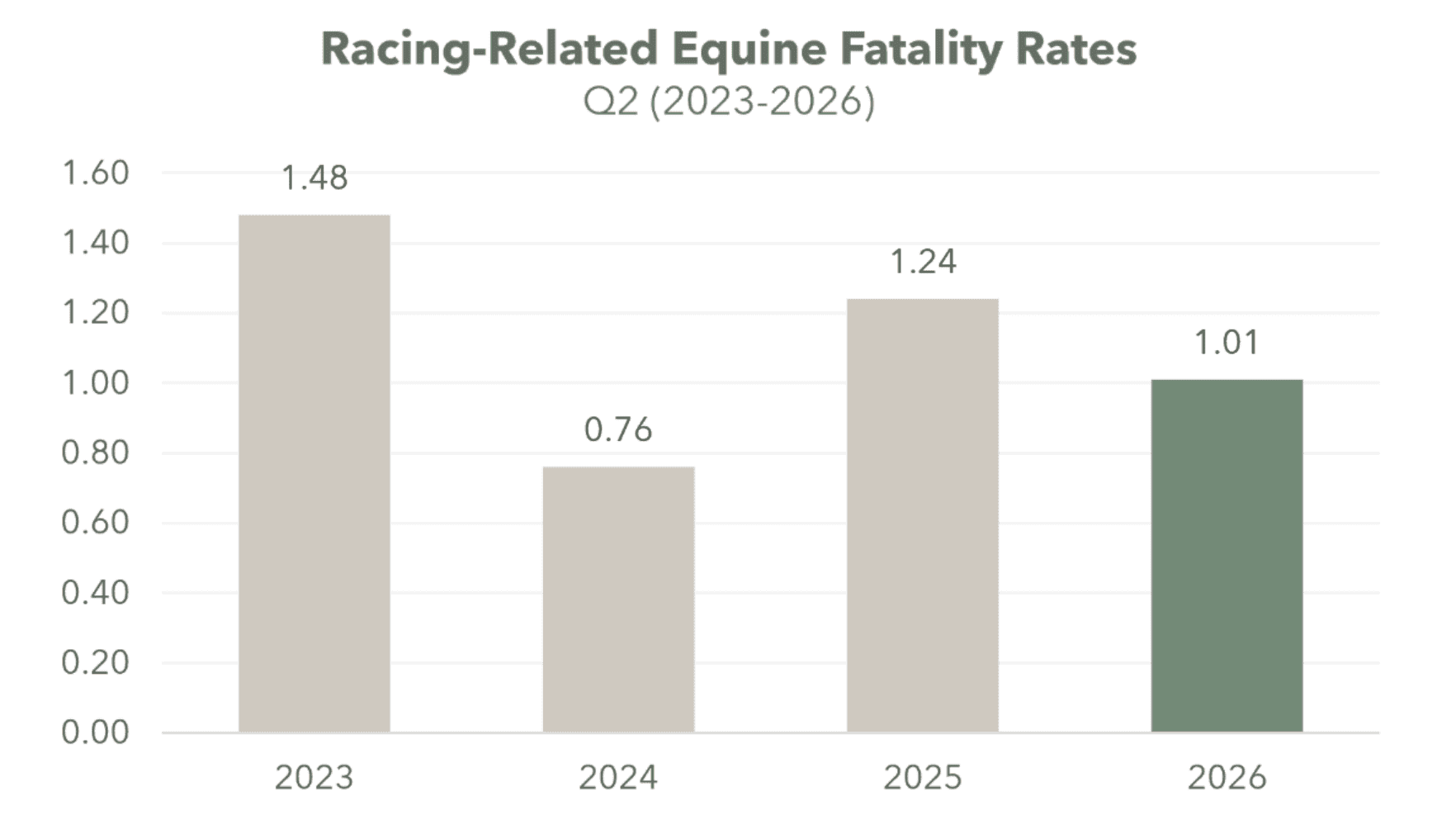
During the second quarter of 2026 (April 1–June 30), racetracks operating under HISA rules reported 1.01 racing-related equine fatalities per 1,000 starts, meaning that 99.90% of starts occurred without a fatality. The rate represents a 9.8% decrease from the cumulative second-quarter rate of 1.12 fatalities per 1,000 starts recorded since 2023 and an 18.5% year-over-year reduction.
Of the racing-related fatalities recorded this quarter, 90.25% were attributable to musculoskeletal causes and 9.75% to sudden death.
New data reported this quarter include delineating fatalities by surface type (e.g., dirt, turf, synthetic), surface condition (e.g., fast, firm, muddy, yielding) and race type (e.g., claiming, allowance, stakes). For the first time, HISA is publishing racing-related equine fatality rates across these categories. Because racing-related fatalities are rare, most of these categories reflect a small number of fatalities, and a change of one or two would move an individual rate substantially. HISA is publishing these figures to establish a baseline and will assess them across multiple quarters before drawing conclusions about any category. Continued data collection will allow HISA’s Racetrack Safety team to identify patterns, pinpoint areas of concern and target opportunities to intervene where appropriate.
Among classifications with at least 1,000 starts during the quarter, racing-related fatalities per 1,000 starts were as follows:
- Surface Type & Condition
- Dirt: 0.93
- Fast: 0.85
- Good: 0.78
- Sloppy: 1.95
- Turf: 1.41
- Firm: 1.54
- Synthetic: 0.40
- Fast: 0.40
- Dirt: 0.93
- Race Type
- Starter Optional Claiming: 1.51
- Maiden Claiming: 1.08
- Maiden Special Weight: 1.07
- Claiming: 0.99
- Allowance: 0.98
- Starter Allowance: 0.83
- Allowance Optional Claiming: 0.78
- Stakes: 0.43
“HISA’s work to make racing as safe as possible requires us to continually find new ways to analyze and understand our fatality data,” HISA CEO Lisa Lazarus said. “By delineating racing-related fatality rates by surface, condition and race type, we are expanding an analysis that we expect will help reduce fatalities and strengthen Thoroughbred racing’s social license to operate. We will continue exploring additional opportunities to enhance safety for both horses and riders.”
Racetracks operating under HISA rules (and training centers owned by them) reported 0.43 training-related deaths per 1,000 workouts in the second quarter of 2026 (approximately a 16% improvement from the same period last year (0.51)). Of the training-related fatalities recorded this quarter, 85.00% were attributable to musculoskeletal causes, 12.50% to sudden death and 2.50% to other causes.
HISA also found that 30,866 unique Covered Horses recorded a published workout or made a start in a Covered Horserace during the second quarter of 2026. Based on this population, the combined racing- and training-related fatality rate was 0.26%. The number of unique Covered Horses with recorded activity rose 7.5% from the second quarter of 2025 (28,707).
HISA Equine Recovery Foundation Impacts
The HISA Equine Recovery Foundation, a 501(c)(3) nonprofit launched in the first quarter of this year, continues to impact fatality rates by providing a safety net for racehorses with career-ending but treatable injuries. HERF provides immediate access to quality veterinary treatment and rehabilitation to support successful retirement. Although HERF initially aimed to take in 15 horses during its first year, it had already accepted 16 by June 30, underscoring the significant need across the industry.
This quarter, HERF saved two horses (Raven & Oscar) from euthanasia; without its intervention, both would have been counted as racing-related fatalities. In that scenario, the quarterly racing-related rate would have been 1.06. Both horses are thriving and are expected to transition to second careers soon.
As with racing-related fatalities, training-related fatalities were positively affected by HERF’s efforts. Four horses (Ryan, Guppy, Mandy & Rooster) who would have otherwise been training-related fatalities were saved from euthanasia in the second quarter. All four horses are thriving and are expected to transition to second careers soon. Without HERF’s interventions, the training-related fatality rate would have been 0.47 this quarter.
Other Key Data
Additional relevant metrics include:
- 7,000 veterinary treatment records per day submitted to the HISA Portal
- 3.59 crop rule violations per 1,000 starts
- 13.5% scratches per entry
The full report can be accessed here. The Horseracing Integrity & Welfare Unit will also release a separate quarterly report detailing metrics from the Anti-Doping and Medication Control Program.
About the Horseracing Integrity and Safety Authority
When the Horseracing Integrity and Safety Act was signed into federal law, it charged the Horseracing Integrity and Safety Authority with proposing and enforcing uniform safety and integrity rules in Thoroughbred racing in the United States. Overseen by the Federal Trade Commission, HISA is implementing, for the first time, a uniform national set of rules applicable to every Thoroughbred racing participant and racetrack facility. HISA has two programs: the Racetrack Safety Program, which went into effect on July 1, 2022, and the Anti-Doping and Medication Control Program, which went into effect on May 22, 2023.
The Racetrack Safety Program includes operational safety rules and national racetrack accreditation standards that seek to enhance equine welfare and minimize equine and jockey injury. The Program expands veterinary oversight, imposes surface maintenance and testing requirements, enhances jockey safety, regulates riding crop use and implements voided claim rules, among other important measures.
The ADMC Program includes a centralized testing and results management process and applies uniform penalties for violations efficiently and consistently across the United States. These rules and enforcement mechanisms are initially administered by an independent body, the Horseracing Integrity & Welfare Unit, established by Drug Free Sport International. HIWU oversees testing, educates stakeholders on the Program, accredits laboratories, investigates potential ADMC violations and penalizes any such violations, subject to the FTC’s plenary review.
Return to the August 25 issue of Wire to Wire