

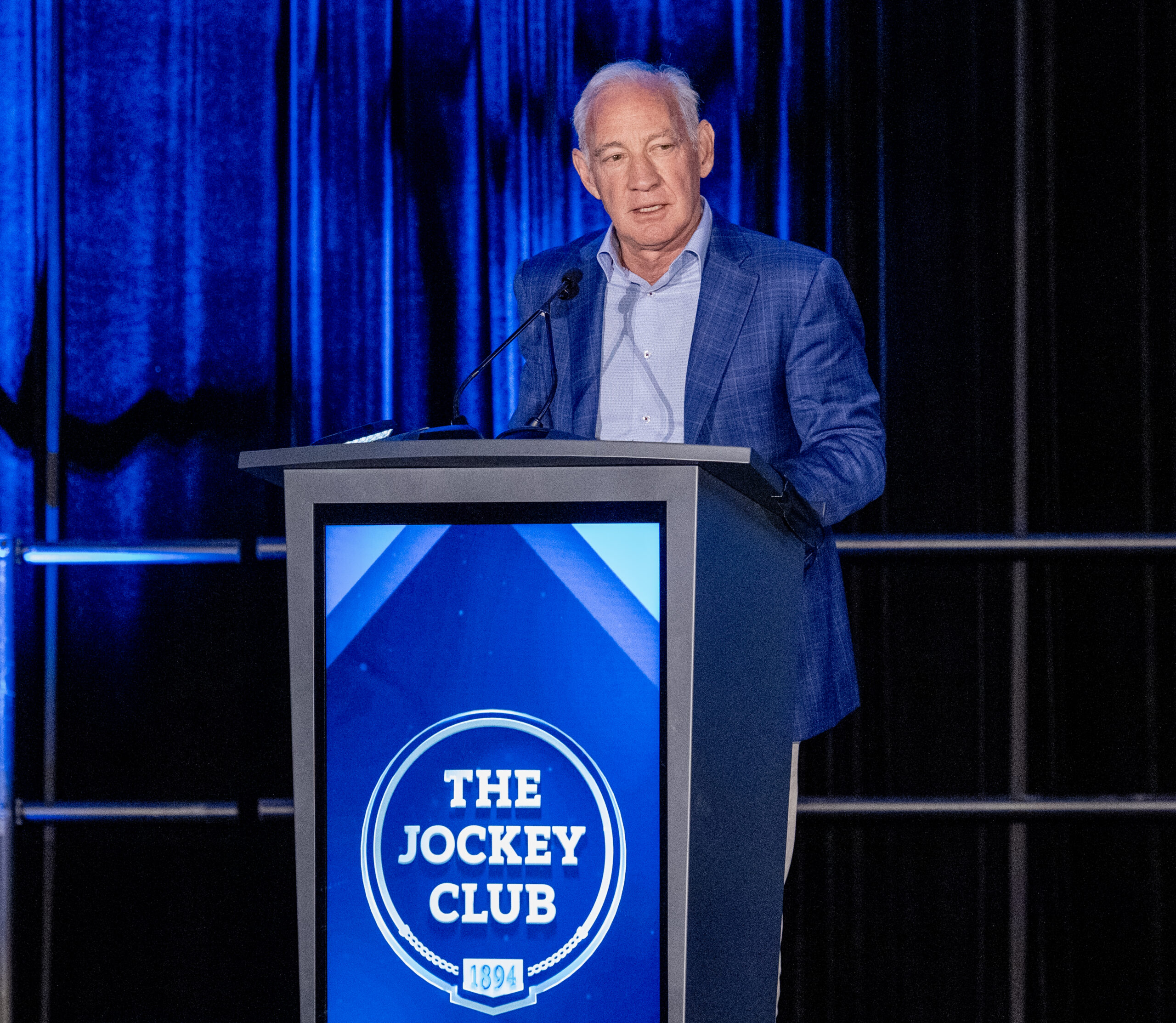
COURTESY THE JOCKEY CLUB NEWS SERVICE (Edited)
SARATOGA SPRINGS, NY—In the keynote address at The Jockey Club’s 74th Annual Round Table Conference on Matters Pertaining to Racing, which concluded Thursday, Greg Maffei, CEO of BANN Ventures and co-founder and chair of Horse Racing League, outlined how he plans to apply to horse racing the marketing, fan engagement and retention strategies that helped transform Formula 1 into a global entertainment powerhouse.
“Today’s fans live the experience of the sport that they’re in. It’s a part of them,” he said. “We hope to engage them in all these ways. The fans that will watch races, follow teams and players, wear the merchandise, have both fantasy and wagers, attend events, debate and create content. The whole experience.”
The conference was held at the Saratoga Springs City Center in Saratoga Springs, New York and streamed on jockeyclub.com. The Jockey Club Chair Everett Dobson opened the conference and delivered the closing remarks. He discussed four priorities that he believes will define the future of our industry: protecting the thoroughbred, growing our sport, strengthening our industry through public policy and collaboration, and preparing the next generation to inherit an industry worthy of its remarkable history.
“Our greatest opportunity lies ahead. I’ll say it again, we’re growing new fans, we’re going to welcome new owners, we’re going to support our breeders, strengthen state racing, expand the reach of our sport and ensure that the thoroughbred remains one of the most admired athletes in the world,” Dobson said in his closing remarks. “The Jockey Club will continue doing its part.”
Victoria Edwards, founder of Frankie Jean Group, was joined by Dan Tordjman, president of TJC Media Ventures/America’s Best Racing, to discuss insights on an expanded industrywide marketing initiative aimed at elevating horse racing’s profile, strengthening the industry’s cultural relevance and growing engagement across all facets of the sport.
“Advertising is what you buy. Marketing is what you build. It is something you can measure,” Edwards said. “And what it builds is a generation of people who watch, who turn up, who spend and who stay.”
Joe Appelbaum, co-founder of Off The Hook and founder and CEO of Waigr, examined the long-term decline in thoroughbred ownership and argued that the industry’s central challenge is not economics, but the owner experience. He said racing must reduce friction and provide greater community, communication, access, and flexibility to retain participants.
“Owner attrition rates are really telling us that owners are willing to pay a premium price for a premium experience,” he said.
Tom Hashimoto, general manager of the New York office of the Japan Racing Association discussed the JRA’s efforts to attract younger generations to the sport and sustain racing’s popularity in Japan.
“While JRA continues to view attracting younger generations as a serious challenge, the reason we have been relatively successful in doing so may be linked to a certain concept JRA has been pursuing for many years,” he said. “That concept is the ‘Pop-ification’ of racing—the extent to which racing feels familiar to the general public and how frequently people can come into contact with it in their daily lives.”
James T. Dresher, chair of the Maryland Jockey Club, provided an update on recent positive developments in Maryland, including the transformation of Pimlico, Laural Park and the Preakness Stakes.
“Maryland breeding and racing has great infrastructure and the industry is part of our state’s culture and legacy,” he said. “With a rebuilt Pimlico racing will be fun and exciting. With a strong breeding incentive program, you want to be here.”
In addition, Charlotte Clement, chief strategy and transformation officer for The Jockey Club, touched on important matters regarding the industry including foal crop, handle, field size and fan base, highlighting how these factors have changed throughout the years and how The Jockey Club is committed to hearing feedback and acting on it.
“Our mandate at The Jockey Club has been clear from your feedback to us. We are a service organization, not just a registry,” Clement said. “We are committed to modernizing the products you interact with daily, to improve how you do what you do every day.”
Kristin Werner, vice president of thoroughbred strategy and industry initiatives at The Jockey Club, reported on The Jockey Club’s Thoroughbred Traceability Initiative, which focuses on understanding what happens to thoroughbred’s after they leave racing or breeding.
“At the end of the day, the more connected that horses stay to owners, to organizations, and to industry resources, the easier they are to trace and the better position we are to support them throughout their lives,” Werner said.
A video replay of the Round Table Conference will be available on The Jockey Club website and an official transcript of the proceedings will be available next week.
Return to the August 7 issue of Wire to Wire